This guide contains affiliate links. As an Amazon Associate I earn from qualifying purchases, at no extra cost to you. See the affiliate disclosure.
The best grow light for herbs on a kitchen counter is a white, full-spectrum LED that you can raise and lower, plugged into a timer. Set it 6 to 12 inches above the plants and run it 12 to 14 hours a day. Those are the distance and hours University of Minnesota Extension gives for lettuce and herbs grown under lights.
This guide explains what to look for rather than naming models. Products change every season, and the checklist at the end works on any product page or box.
The best grow light for herbs, in short
| Feature | What to choose | Why |
|---|---|---|
| Bulb type | LED | Very energy efficient, long-lasting, and gives off little heat. |
| Light color | White, also sold as “full spectrum” or “balanced” | Suits most plants at any stage, and your herbs still look green. |
| Height | Adjustable | The right distance changes as the plants grow. |
| Timer | Built in, or a cheap plug-in outlet timer | Plants need a steady day length and a dark period. |
| Brightness | A plant-light rating (PPF or PPFD) if the maker gives one | Watts and lumens do not tell you how much light the plant can use. |
Do you need a grow light at all?
Maybe not. Penn State Extension says most herbs need 6 hours of direct sunlight, and a window with a southern exposure can supply that for much of the year. If you have one, start there.
You probably do need a light if your windows face north, if buildings or trees shade them, or if it is winter. Iowa State notes that nearly all indoor plants benefit from some extra light during winter. The plants will tell you: Penn State describes herbs short on light as thin and spindly, with smaller leaves and less aroma. Before you buy anything, it is worth checking our list of herbs that grow in low light, because picking a more tolerant herb is cheaper than buying a lamp.
LED, fluorescent or incandescent?
University of Minnesota Extension compares the bulb types you will see in stores. In short:
| Type | Good | Not so good |
|---|---|---|
| LED | Very energy efficient, long-lasting, wide spectrum, little heat, many shapes and sizes | Costs more up front; bright light can be distracting in a living space |
| Fluorescent | Cheaper to buy, moderately efficient | Uses more energy and wears out sooner than LED; some tubes are mostly blue-green, so check the label |
| Incandescent | Cheapest to buy | Wastes energy, runs hot, and its light makes plants stretch |
For herbs on a kitchen counter, LED is the easy choice. The low heat matters most, because the light has to sit close to the leaves.
What the numbers on the box mean
Grow lights are hard to compare because makers report brightness in different ways. Minnesota Extension explains the common ones:
- Watts measure the electricity the light uses, not how much light comes out. An efficient light gives more light for fewer watts.
- Lumens measure brightness as the human eye sees it. They miss some of the wavelengths plants use, so they are only a rough guide.
- PPF (photosynthetic photon flux) measures the plant-usable light a bulb gives off each second. This is the most useful number.
- PPFD is that same plant-usable light measured where it lands, such as on a leaf. It drops as the light moves farther from the plant.
If a product lists only watts, or an “equivalent to 100 watts” claim, you have no real way to judge it. Prefer one that states PPF or PPFD at a given distance.
You do not strictly need a product sold as a grow light. Iowa State University Extension gives a recipe built from an ordinary fixture: a standard 4-foot plug-in LED shop light, full spectrum (often labeled “daylight”), putting out at least 3,000 lumens, hung 18 inches above the foliage and run 14 hours a day. That is more light than two pots of basil need, but it is an inexpensive way to light a whole shelf.
White light or the purple kind?
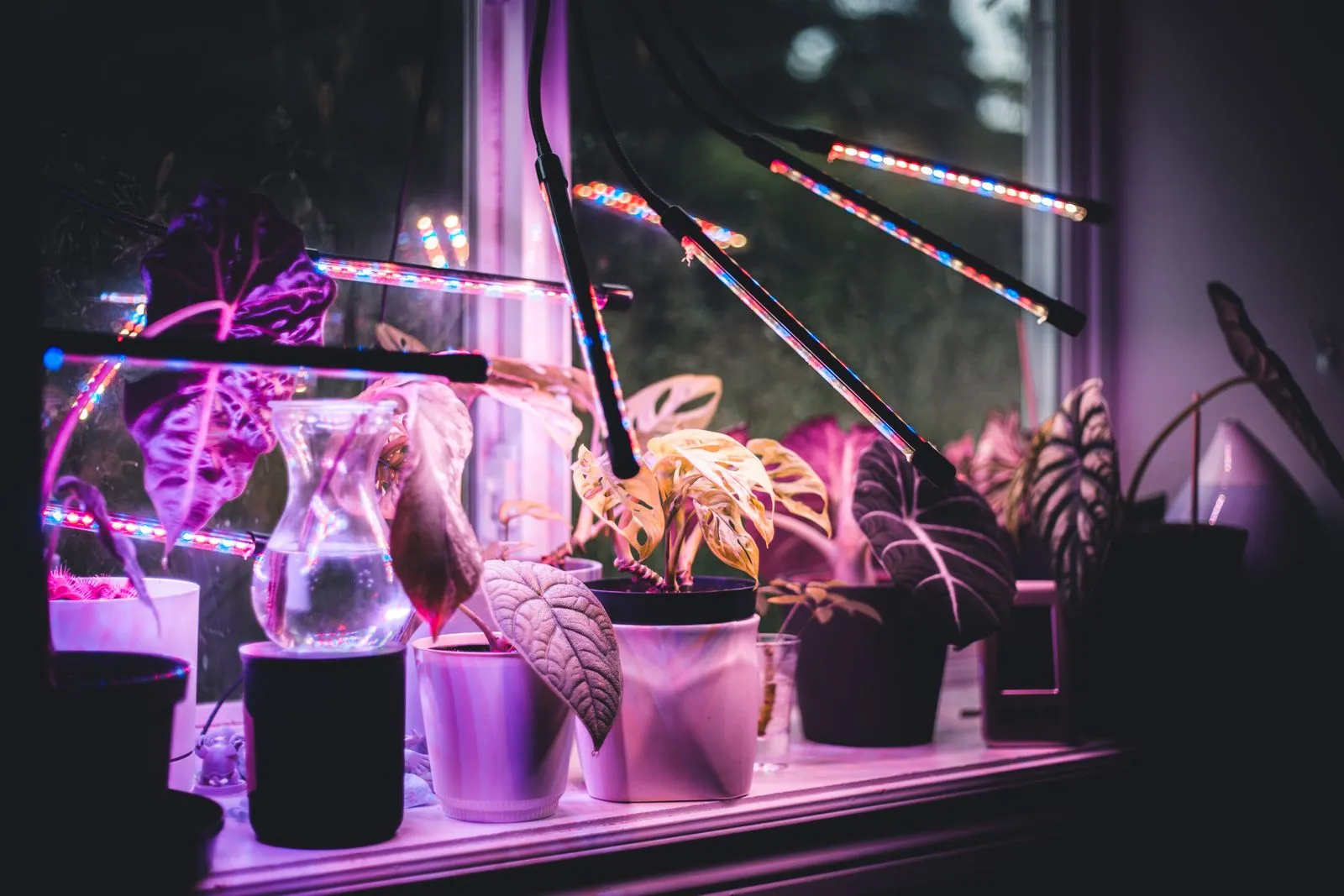
Plants mostly use red and blue light, which is why some grow lights emit only those colors and glow purple. Minnesota Extension says blue or mixed light suits leafy plants, red or mixed light promotes flowering, and white or balanced light suits most plants at any stage of growth.
Herbs are grown for leaves, so either works. In a kitchen, white is far more pleasant to live with, and it lets you see the true color of the leaves, which is how you spot yellowing or pests early.
How far away and how many hours
The extension services give slightly different figures, because they are describing different lights:
| Source | Distance from plants | Hours per day |
|---|---|---|
| University of Minnesota (lettuce and herbs under lights) | 6 to 12 inches | 12 to 14 |
| Iowa State (general) | LED 12 to 24 inches; fluorescent 6 to 12 inches | 12 to 14 for most plants; no fewer than 10, no more than 16 |
| Penn State (herbs, two 40-watt cool white fluorescent tubes) | 6 to 12 inches | 14 to 16 |
A workable starting point for a small LED is about 12 inches above the tops of the plants for 14 hours a day. Follow the directions that came with the light if they differ, then adjust to what you see.
Use a timer. Iowa State stresses that plants still need a period of darkness to grow properly, so leaving the light on around the clock is not better.
Let the plants correct you
Iowa State recommends plain trial and error for home gardeners: set the light up, watch for a few weeks, and adjust.
- Stretching, spindly stems, yellowing or dropping leaves: too little light. Move the light closer, add a second one, or run it longer.
- Scorched or bleached patches, very compact growth, reddened leaves: too much light. Raise the light.
- Plants leaning to one side: the light is off-center. Move it, or turn the pots every few days.
Raise the light as the plants grow so the distance stays the same. That is the reason adjustable height is on the must-have list.
Which style fits your setup
- One or two pots: a clip-on or gooseneck LED, or a grow bulb in a desk lamp. Iowa State shows exactly that as a small homemade setup.
- A row of pots on a counter or shelf: an LED bar or strip mounted under the cabinet or shelf above.
- Everything in one box: a countertop herb garden kit with its own adjustable light and tray. Tidy, but you pay for the convenience.
- A full shelf of plants: LED shop lights hung on chains from wire shelving, which Iowa State calls an economical setup.
For ideas on where the pots themselves can go, see our kitchen herb garden ideas.
What it costs to run
Very little. In a worked example, Minnesota Extension figures that a single 9-watt LED grow light running 14 hours a day costs about 45 cents a month in electricity, at 12 cents per kilowatt-hour. Your rate will differ, but a small LED will not show up on the power bill.
Shopping checklist
- LED, not incandescent.
- White, full-spectrum or balanced light.
- Height or angle you can adjust.
- A timer, or room in the budget for a plug-in one.
- A PPF or PPFD figure, not just watts.
- Wide enough to cover all your pots, not only the middle one.
- A plug and cord that reach your outlet safely, away from the sink.
Once the light is up, the rest is ordinary care. Start with the best herbs to grow indoors, or go straight to our guides for basil and mint. If you are curious about growing without soil, a grow light is also the heart of a home hydroponic herb setup.
Browse grow lights on Amazon
- Full-spectrum LED grow light bars: for a shelf or the underside of a cabinet
- Clip-on LED grow lights: for one or two pots on a sill or desk
- LED grow bulbs: these screw into an ordinary lamp socket
- Plug-in outlet timers: so the light runs the same hours every day
These links open Amazon search results, so you can compare what is in stock and read the reviews. Indoor Herb Guide has not tested individual products. As an Amazon Associate I earn from qualifying purchases.
Sources
- Lighting for indoor plants and starting seeds, University of Minnesota Extension
- How to Set Up Supplemental Lights for Indoor Plants, Iowa State University Extension
- Growing Herbs Indoors, Penn State Extension
- Small-scale hydroponics, University of Minnesota Extension