
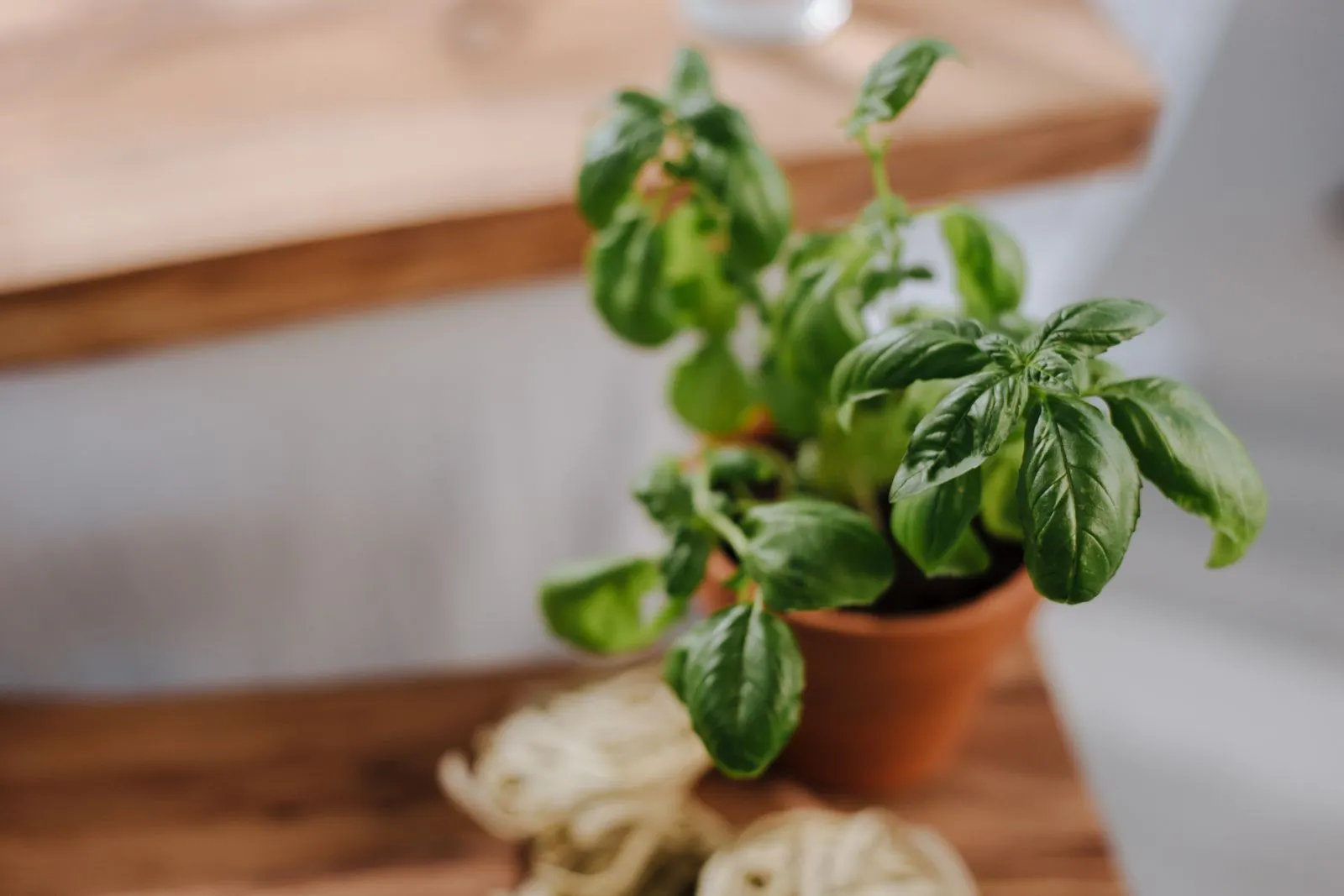
You can grow basil indoors all year if you give it three things: strong light, a room that stays above 50°F, and potting mix that never dries out completely. Get those right and the rest is easy.
How to grow basil indoors at a glance
| What it needs | The target |
|---|---|
| Light from a window | About 6 hours of direct sun a day, ideally a south-facing window |
| Light from a lamp | 12 to 16 hours a day, with the light 6 to 12 inches above the plant |
| Temperature | 65 to 70°F by day, never below 50°F |
| Pot | At least 6 inches wide, with a drainage hole |
| Water | When the surface feels dry, before the plant wilts |
| Feeding | A weak dose of liquid fertilizer every 2 weeks |
| Harvest | Cut stems back often and remove flower buds |
Light decides everything
Light is where most indoor basil fails. Penn State Extension says most herbs need about 6 hours of direct sunlight, and that plants kept in too little light turn thin and spindly, with smaller leaves and less aroma. That description fits most struggling kitchen basil.
A south-facing window is the best natural spot. Turn the pot every few days so each side gets its share and the plant grows evenly.
If your windows fall short, especially in winter, use a grow light. Iowa State University Extension suggests putting a full-spectrum LED or fluorescent grow light on a timer for 12 to 16 hours a day, and notes that long, lanky growth is the sign that a plant wants more light. University of Illinois Extension places the light 6 to 12 inches above the plant.
Keep it warm, and off cold glass
Basil is a warm-weather plant. Penn State Extension recommends rooms of 65 to 70°F during the day and 55 to 60°F at night for indoor herbs, and warns that basil cannot survive below 50°F. For that reason it advises against keeping basil on a windowsill in winter, where the air next to the glass can be far colder than the room.
In cold months, move the pot a little back from the window at night, or grow it under a lamp away from the window altogether. Keep it clear of heating vents too, which dry the leaves.
Choose the right pot and soil
- Size: a container at least 6 inches across gives the roots room. University of Illinois Extension uses that as its minimum for indoor herbs.
- Drainage: the pot must have a hole in the bottom. Basil likes steady moisture, but roots sitting in water rot.
- Soil: use a well-drained potting mix, not soil from the garden.
- Material: terracotta is porous and dries faster, which suits forgetful waterers less and heavy waterers more. Plastic and glazed ceramic hold moisture longer.
Water before it wilts
Basil is thirstier than woody herbs like rosemary and thyme. Penn State Extension is direct about it: never let basil’s potting mix dry out completely.
Push a finger into the top of the mix. When it feels dry, water slowly until a little runs out of the drainage hole, then empty the saucer. Iowa State’s rule of thumb is to water once the mix is dry to the touch but before the plant begins to wilt.
Feed lightly
Both Penn State and Illinois recommend a low dose of water-soluble fertilizer about every 2 weeks, and both warn that feeding more than that can weaken an herb’s aroma and taste. Iowa State suggests mixing an all-purpose fertilizer at half or quarter strength. With basil, less is better.
Harvest so it keeps producing
How you pick basil matters as much as how you grow it. Plucking single leaves from the bottom leaves you with a tall, bare stem. Cutting stems makes the plant branch.
- Wait until the plant has several sets of leaves.
- Cut a stem just above a pair of leaves. Two new shoots will grow from that point.
- Repeat on other stems every week or two, and never remove more than about a third of the plant at once.
- Pinch off flower buds as soon as you see them.
University of Illinois Extension gives the same advice: trim often so plants stay compact, cut a few inches down the stem instead of picking individual leaves, and stop the plant flowering, because flowering reduces flavor.
Seed or store-bought plant?
- From seed: sow a few seeds on moist potting mix, cover them lightly and keep the pot warm. Basil is an annual, so Iowa State recommends staggering sowings through the winter to always have a young plant coming along.
- From a supermarket pot: those pots are usually many seedlings crowded together. Gently split the clump into three or four pieces and give each its own pot, and they will last far longer.
Common problems
- Tall, floppy stems with small leaves: not enough light. Move it to a brighter window or add a grow light, then cut the stems back to a leaf pair.
- Yellow lower leaves and soggy soil: too much water or poor drainage. Let the surface dry before watering again.
- Black or drooping leaves after a cold night: cold damage. Move the plant away from the glass.
- Tiny flies around the soil: fungus gnats, which breed in wet potting mix. Penn State suggests yellow sticky traps and better watering habits.
Sources
- Growing Herbs Indoors, Penn State Extension
- Herbs all winter: grow them indoors, University of Illinois Extension
- Can I grow herbs indoors over the winter?, Iowa State University Extension